Living Lab Features
Below are some of the special features of this living lab that offer unique teaching, learning, and research opportunities.


For Instructors:
This living lab provides a valuable resource for instructors at the University of Iowa and beyond to enhance their educational objectives. Our team has identified specific connections to a diverse array of academic disciplines. Instructors are encouraged to bring their students to the site to engage with these curricular linkages firsthand, fostering experiential learning. Additionally, students are invited to utilize the space for research and exploration, allowing them to deepen their understanding of the interplay between nature and their field of study.
Curricular Connections
Environmental Science
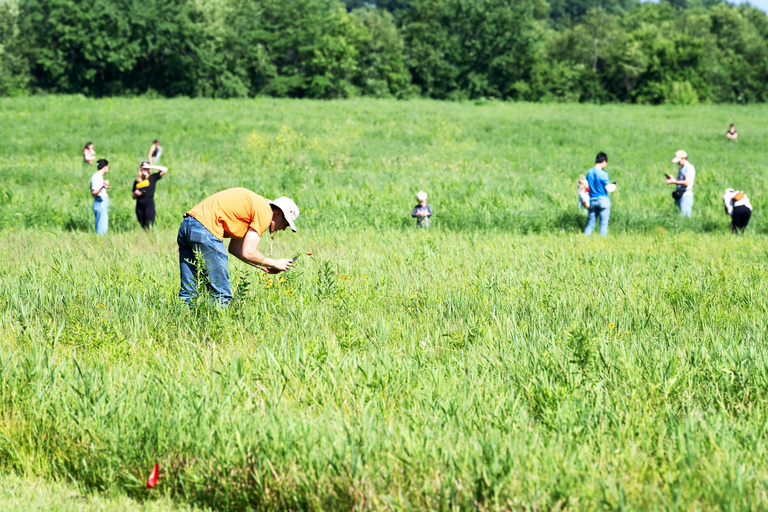
Conduct species inventories and habitat assessments as part of the Vascular Plant Inventory Project.
Investigate local geology by analyzing Devonian bedrock formations and glacial soil layers exposed along the lake and ravines.
Study watershed dynamics and floodplain processes by collecting field data on erosion, runoff, and sedimentation patterns.
History
Research the cultural history of the “Big Grove,” including Indigenous land use, settler impacts, and conservation efforts.
Research the historical timeline of MNRA through the Facilities Management website and other sources: https://facilities.uiowa.edu/macbride-nature-recreation-area#accordion-item-5691-0
Geography
Use GIS to map erosion, trail systems, habitat types, and human impact across the MNRA landscape.
Create spatial visualizations identifying areas that need interventions such as trail work and biodiversity protection.
Art, Photography, & Creative Writing
Produce creative projects such as poems, short stories, paintings, or photo essays inspired by the natural surroundings.
Document landscape changes, wildlife encounters, or quiet moments on the trail as part of a nature journaling assignment.
Teaching & Learning
Design nature-based lesson plans and outdoor classroom strategies for K–12 or university students.
Practice experiential teaching techniques and environmental interpretation using the site’s diverse learning settings.
Public Policy
Analyze public land use and conservation policy using MNRA as a case study in long-term and multi-agency management.
Participate in hands-on learning with the Hubbell Environmental Law Initiative’s hybrid course on wildlife and conservation law.
Communications & Media
Create promotional materials such as trail maps, social media campaigns, or short videos to highlight MNRA features and events.
Interview students, staff, and community members for storytelling projects that document the area’s ecological and cultural value.
Assignment Development
Discussion Questions
What role do programs like the Iowa Raptor Project play in connecting scientific research with public education, and how might this model be applied in other fields?
How does MNRA balance recreation, research, and ecological preservation? Why is this important?
Interpretive Prompts
Spend time along one of MNRA’s floodplain trails or near the Devonian bedrock outcrops. What do you notice about how the land has been shaped by water over time? Sketch or describe changes in topography, erosion, or vegetation.
Visit the bird blind or a prairie trail and document wildlife activity, changes in season, or evidence of human impact. Reflect on how these elements influence your perception of the land’s value.
Analysis Prompts
Analyze trail erosion or sediment buildup using GPS/GIS mapping tools. Propose a restoration strategy based on your findings, considering both ecological needs, visitor use, and policy restrictions.
Research historical land use in the MNRA area using the provided resources, your own sources, or a combination of both. How has the landscape changed, and what factors (natural or human) have driven those changes?
Resources:
Testimonials

“The Macbride Recreation Area has been a great place to go that is connected to the university. There are many native plants and trails that make it an enjoyable place to research.”

"The Macbride Nature Recreation Area, originally named the Macbride Field Campus, is an amazing remnant of Big Grove – a White Oak savanna complex in our area. The biodiversity, as well, as being scenically situated between Lake Macbride and the Coralville Reservoir, makes this a truly inspiring 'field campus'. The Iowa Raptor Project (1985), Iowa Wildlife Camps (1991) and School of the Wild (1998) all were built on it, capitalizing on the diverse and abundant flora and fauna to connect generations of students to the Wild. These programs now form the UI WILD Department in the College of Education."

"We should be utilizing Lake Macbride for classes and research!!"
Macbride Nature Recreation Area Stakeholders
Click below to search a directory of caretakers, researchers, stakeholders, and people involved with Macbride Nature Recreation Area.
Submit Your Feedback or Questions