What is a Living Lab?

A living lab is a dynamic space that leverages campus for experiential learning through teaching and research beyond the traditional classroom. It also fosters improved mental health and overall well-being for both campus and community members.

Where are the Living Labs?

Living labs are everywhere!  They are any place on campus that can be used for teaching, learning, or research.  Below are a few examples of spaces to explore.
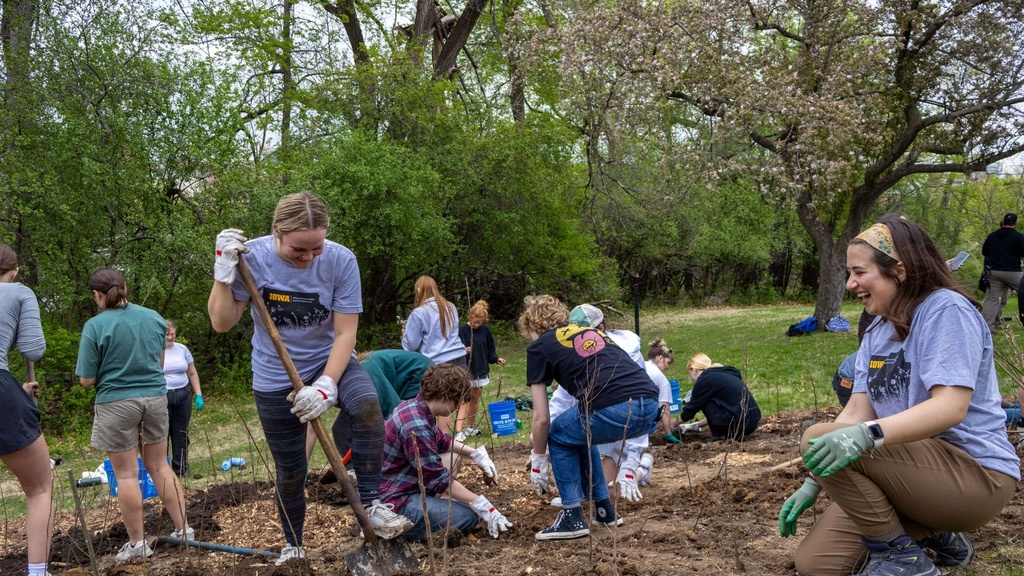
Tree Planting

The Andy Dahl Miyawaki Forest

The Andy Dahl Miyawaki Forest is a half-acre reforestation site located on the hillside northeast of Hillcrest Residence Hall and the largest Miyawaki forest in Iowa. As a living lab, the forest offers a unique, hands-on environment for students to learn about ecological restoration, sustainability, and the importance of campus and community collaboration.
Pharmacy Building and Roots of Medicine

Roots of Medicine

Roots of Medicine is medicinal garden formed as a collaboration between the College of Pharmacy, Hardin Library for the Health Sciences, and community members. Historical drawings and prints of the plants, information on the plant’s historical and modern medicinal uses, and a feed of the most current research are all provided through QR codes in the garden.
ashton priaire

Ashton Prairie Living Laboratory

Situated on the University of Iowa's Ashton Cross Country Course, the Ashton Prairie Living Laboratory (APLL) is an educational and research facility for UI students and researchers and the local community.

What do Hawkeyes Say About Living Labs?

"These spaces are vital to the student experience and the success of our classes."

So Many Researchers on Campus, So Much of Campus to Research

people collecting field data

1 in 3

undergraduates participate in research at the University of Iowa
bioblitz at ashton

31 +

Locations Identified As Potential Living Laboratories
bioblitz microscope

1900 +

Acres of land to explore on campus

Did you know?

Spending time in greenspaces on campus improves cognitive function​, reduces stress, reduces risk of cardiovascular and respiratory mortality​, and reduces social isolation!

Living Labs Support the University of Iowa Strategic Plan

Events

2026 Environmental Law Seminar promotional image

2026 Environmental Law Seminar

Friday, November 13, 2026 8:00am to 5:00pm
Boyd Law Building

The 2026 Environmental Law Seminar is a dynamic CLE program navigating the intricacies of environmental law and its broader impact. Propel your practice forward by being a pioneer in environmental law's evolution in Iowa.

REGISTRATION FEES

$175.00 ISBA Members or Non-ISBA Members (Over 5 Years of Practice)

$150.00 ISBA Members or Non-ISBA Members (Less than 5 Years of Practice) or Public Serving Lawyers

FREE Law Students FREE ISBA CLE Season Pass Holders

Register here: https://www.iowabar.org/?pg...

Polytemporality, or Animation's Plastic Approach to the Prehistoric  promotional image

Polytemporality, or Animation's Plastic Approach to the Prehistoric

Friday, November 13, 2026 3:30pm to 5:00pm
Adler Journalism and Mass Communication Building
A presentation by Scott Curtis (Northwestern University). This presentation looks at a mid-century animated depictions of deep time - such as the formation of oil deposits - to explore animation’s ability to compose multiple rates of change within the same frame and to juxtapose different orders of time. If, as Heather Davis argues, plastic embodies polytemporality as matter, animation performs it as duration, making it a privileged representational form for discussions of deep time and the Anthropocene. Friday, November 13th, 2026. 3:30 p.m. to 4:30 p.m. E105 Adler Journalism Building.
Saw-whet Owl Banding promotional image

Saw-whet Owl Banding

Friday, November 13, 2026 7:00pm to 10:00pm
Iowa Raptor Project

ALL DATES ARE SOLD OUT!!

Join us after dark for this exclusive Northern Saw-whet Owl banding event! We will begin indoors at the Raptor Center for an engaging educational program to learn more about the secretive world of owls with our education birds. Next, you will be transported to our remote owl banding station where you will help collect data, band, and release owls that we may encounter. Due to the nature of this event, space is limited. Registrants must be 18 years of age or older to...